
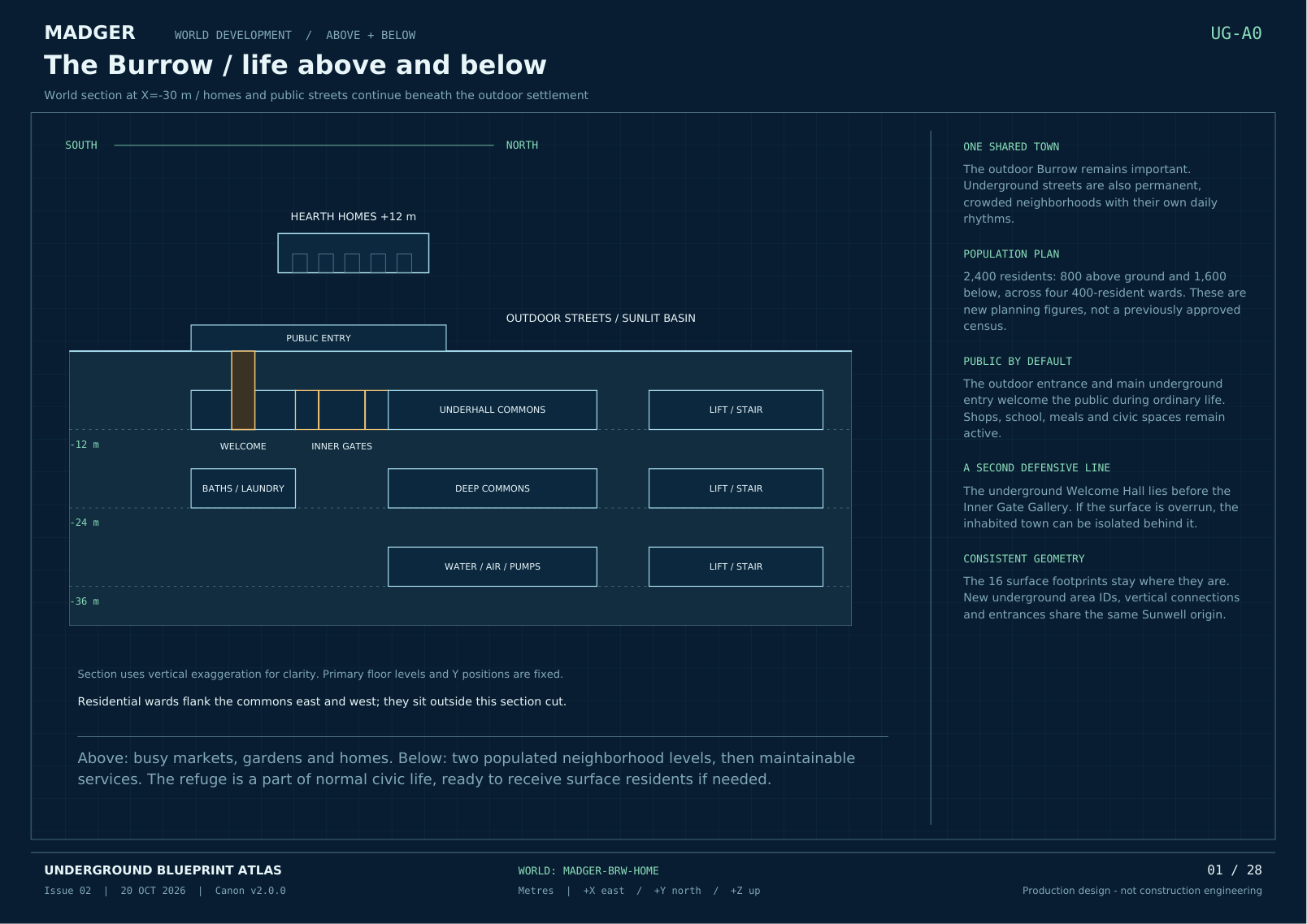
On October 20, MADGER published a versioned production system for The Burrow: a current-version pointer, a 26-page Living World volume, structured canon, resident and location registers, rebuildable source, a 28-page underground blueprint atlas, and the earlier surface atlas. The work is public in the same repository as the website, so a creator does not have to rely on a private message, an isolated image, or somebody’s memory.
That is a practical community utility. It gives writers, artists, animators, game designers, moderators, and reviewers a shared reference before they contribute. It also gives the audience a way to distinguish official canon from a draft, a visual study, or an enthusiastic fan interpretation.
The reader benefit: create without guessing
A memorable character alone does not solve collaboration. The difficult part is preserving continuity when multiple people produce scenes, art, rooms, maps, and stories over time. If every creator invents a new entrance, changes a district’s purpose, or moves a landmark to make one image easier, the world stops behaving like a place and starts behaving like unrelated prompts.
The public World Bible reduces that friction. A contributor can begin with the immutable v2.1.0 edition, confirm which facts are fixed, identify which questions are intentionally open, and attach a proposed scene to an existing location ID. Review can then focus on whether the idea works—not on reconstructing basic continuity after the work is finished.
What actually shipped
| Public artifact | What a creator can do with it | Evidence boundary |
|---|---|---|
| Current-version pointer | Resolve the edition that controls when older files conflict. | It records repository canon; it is not proof that every video or game build uses it. |
| 26-page Living World | Understand present-day neighborhoods, routines, civic life, and eight recurring residents. | New resident appearance notes are working specifications, not final model sheets. |
| Structured JSON | Search locations, residents, relationships, access states, and stable IDs without extracting a PDF by hand. | Structured data improves consistency; it does not make authored assumptions factual outside the fictional world. |
| Blueprint atlases | Place scenes across 16 surface and 21 underground areas using registered connections and levels. | These are fictional production layouts, not construction or evacuation engineering. |
| Validation and source | Rebuild the volume and inspect checks for IDs, references, footprints, routes, and page layout. | A passing document check is not a physical-device, gameplay, or audience-quality test. |
The v2.1.0 validation record reports preserved footprints and route graphs, unique IDs, valid resident references, subplans within their parent areas, and a visual review of all 26 rendered pages. The earlier underground-atlas record separately checks route reachability, water crossings, level plans, and its 28 rendered sheets.
How to verify the canon in five minutes
- Start at the pointer. Open CURRENT.json. It names the active edition and explains precedence.
- Freeze the evidence. For a production brief, use the linked commit edition rather than assuming the main branch will never change.
- Read the edition limits. The v2.1.0 guide says what was developed, what remains unassigned, and what the imagery cannot override.
- Use data for facts and blueprints for space. The complete JSON is the searchable record; the atlases are the measured visual reference.
- Check the validation file. Read the limits as carefully as the passed checks. A transparent system tells you where confidence ends.
A contribution workflow that protects both sides
The most useful next step is not asking creators to “make something cool.” It is giving them a bounded starting point. A MADGER contribution can now identify an edition, location ID, time or event state, affected characters, required brand assets, and the canon questions it does not answer. That reduces unpaid revision loops and makes approvals easier to explain.
A practical brief should include:
- Canon version: the exact edition or commit used for the work.
- Location: the registered area and level, plus any connected route relevant to the scene.
- Known facts: only established relationships, access states, events, and visual rules.
- Creative room: the specific choices the creator is invited to make.
- Approval boundary: whether the output is a draft, an atmosphere study, a fan contribution, or adopted canon.
- Deliverable terms: format, deadline, revisions, credit, usage rights, and compensation when applicable.
This extends MADGER’s existing creator trust standard with a better source package. It does not replace a written scope, permission, or fair treatment. Public references make the work clearer; they do not make every contribution automatically official.
What this release does not claim
The repository explicitly says the archives do not claim that released game or video content has been rebuilt against the map. Exterior geography, the attacker’s identity, detailed founding history, character origin biographies, and several model sheets remain incomplete in the current public edition. Story seeds are not historical events, and game progression is separate from story canon.
The World Bible is also not an investment promise. A stronger creative system can improve consistency and make participation more useful, but it does not guarantee audience growth, adoption, token demand, liquidity, or returns. Crypto assets remain risky, and readers should not treat production volume as proof of financial value.
The utility-first test
The useful question is simple: can somebody do better work because this exists? Here, the answer is testable. A creator can find the current record, download the source material, reference stable locations, check unanswered questions, and submit work with fewer hidden assumptions. A reviewer can cite the same evidence. A community member can challenge a contradiction without needing privileged access.
That is modest utility, but it is real utility: shared context, lower coordination cost, clearer authorship, and a public correction path. MADGER the character makes the world recognizable. The system around the character makes that world easier for people to build together.